
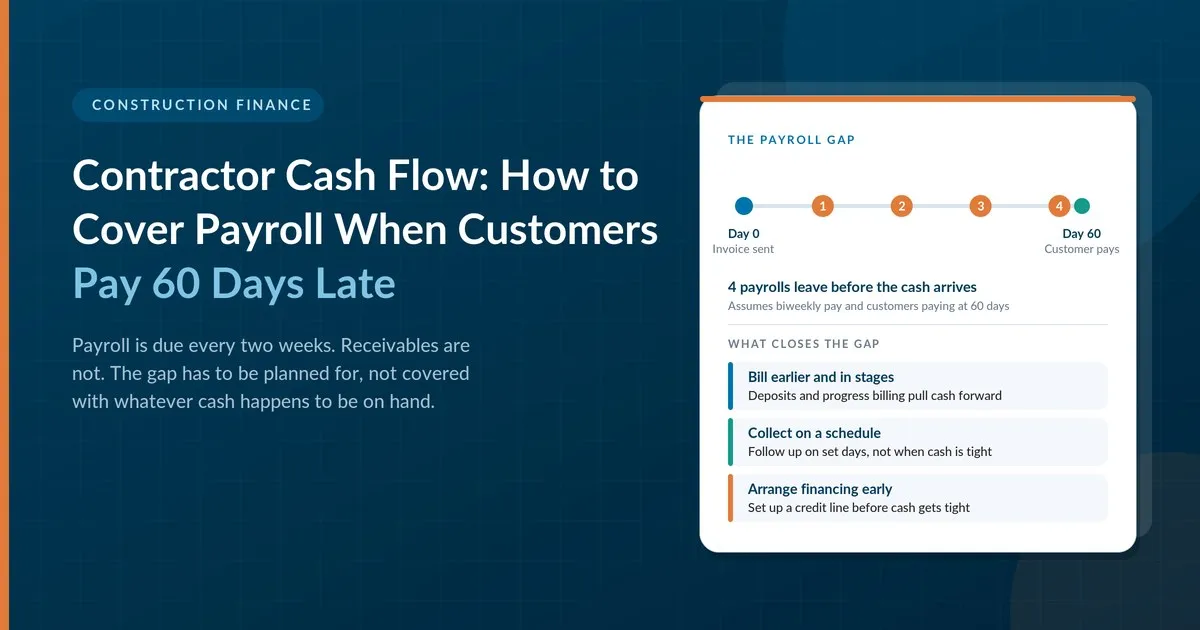
Payroll runs every Friday. Your customers pay whenever their own process allows, and that is often 45 to 60 days after you send the invoice. In between, your crews, suppliers, and fuel cards all need cash today.
I see this gap in nearly every contractor we work with. It rarely means the business is unprofitable. It means the business is growing faster than its cash cycle. This guide explains how to measure the gap, shrink it, and fund what remains, so payroll never depends on a customer’s mood.
Why Profitable Contractors Still Run Short of Cash
A contractor pays for a job in stages: materials first, then labor each week, then insurance, fuel, and equipment. The customer pays at the end, or in a few steps, usually weeks after the work.
Here is the math in plain terms. Say you pay crews $10,000 a week. A customer pays 60 days after invoice. Sixty days is about 8.6 weeks, so you fund roughly $86,000 of payroll before that money returns. That is $10,000 × 8.6, rounded.
None of this shows up on a profit and loss report. The report may show a healthy profit while the bank balance drops. Profit measures what you earned. Cash measures what you can spend on Friday. For contractors, the two can sit far apart.
Step One: Measure the Gap
Before you fix anything, know your numbers. Two figures matter most:
- Days to collect. The average number of days between sending an invoice and receiving payment.
- Weekly cash burn. Payroll, materials, and fixed costs you must pay each week, whether or not customers have paid.
Multiply weekly burn by the weeks you wait to get paid. That number is the cash you must have available at all times. If it is larger than your bank balance plus available credit, you have found the source of the stress.
Firms that provide bookkeeping services for roofing contractors and other trades should be able to produce these numbers every month, by job. If your bookkeeper cannot, that is the first thing to fix.
Build a 13-Week Cash Forecast
A 13-week forecast is the most practical tool for this problem. It looks one quarter ahead and shows when cash will be tight, so you can act weeks early instead of days early.
The layout is simple:
| Row | What goes in it |
|---|---|
| Starting cash | Bank balance at the beginning of the week |
| Expected receipts | Invoices you expect to be paid that week, based on past customer behavior |
| Payroll and payroll taxes | The full amount, including employer taxes |
| Materials and subcontractors | Bills due that week |
| Fixed costs | Insurance, rent, loan payments, software |
| Ending cash | Starting cash plus receipts minus payments |
Update it every week. Use realistic payment dates, not invoice due dates. If a customer has never paid on time, forecast the real date. The goal is an honest picture, not an optimistic one.
For a deeper look at cash planning in the trades, see this cash flow for contractors guide.
Shrink the Gap: Bill Earlier and Collect Sooner
Every day you cut from the collection cycle returns cash directly. These changes work without any outside financing.
Take deposits. A deposit of 25% to 30% at signing covers early materials and reduces how much you float.
Use progress billing. Bill at set milestones, such as materials delivered, work half done, and completion. Do not wait for the end of the job.
Invoice the same day. Many contractors wait a week to send paperwork. That week adds a week to the cycle.
Make payment easy. Offer card, ACH bank transfer, and online payment links. The fewer steps for the customer, the sooner you are paid.
Send reminders on a schedule. A fixed routine beats ad hoc follow-up:
| Day | Action |
|---|---|
| Day 1 | Invoice sent with clear terms and payment link |
| Day 15 | Friendly reminder |
| Day 30 | Phone call and written reminder |
| Day 45 | Formal notice and a conversation about timing |
| Day 60 | Escalate according to your contract |
Roofing work adds one more factor. On insurance claim jobs, the carrier often pays part of the claim up front and releases the rest after the work is complete and documentation is submitted. Track what each customer owes, what the insurer owes, and when each payment is expected. Treat them as separate receivables.
Contract terms matter as well. Write payment terms, late fees, and lien rights into your agreements. Deadlines for lien notices vary by state, so confirm yours with a construction attorney before the first job, not after the first late payment.
Protect Payroll First
When cash runs short, payroll must come first, and payroll taxes need special care. The money withheld from employee paychecks, plus the employer’s share, has to be deposited on a schedule. The IRS outlines these rules in its guidance on depositing and reporting employment taxes.
A simple habit protects you. Every payday, move the payroll tax amount into a separate savings account. Do not let it mix with operating cash. That one step prevents a short-term gap from turning into a tax problem.
Other protections to put in place:
- Keep a cash reserve equal to at least two to four weeks of payroll if you can.
- Pay crews on a consistent schedule so they can plan.
- Talk to suppliers early if a payment will be late. Most prefer a call to a surprise.
Fund What Remains: Know Your Options
After you shrink the gap, you may still need working capital. Compare the main options on cost and flexibility.
| Option | Strength | Trade-off |
|---|---|---|
| Business line of credit | Flexible, pay interest only on what you use | Needs to be set up before you need it |
| Invoice financing | Cash against unpaid invoices within days | Higher cost per dollar, and it may involve your customers |
| Supplier terms | Extends your payables with no interest | Depends on supplier relationships and your payment history |
| Equipment or term loan | Fixed payments | Fits purchases, not weekly cash gaps |
Set up the line of credit when your numbers look strong, not during a shortage. Lenders respond to clean, current financial statements, which is one more reason to keep the books up to date every month.
Use financing for timing gaps, not for losses. If a job loses money, borrowing only delays the problem.
A Simple Monthly Routine
- Update the 13-week forecast every Monday.
- Review the aging report, which lists unpaid invoices by how long they have been open.
- Follow up on every invoice past its due date.
- Check job profit reports to confirm each job earns what you expected.
- Move payroll tax money into its separate account on every payday.
- Review your credit line and reserve every month.
Final Thought
Late-paying customers are a fact of contracting, but cash shortages do not have to be. Measure your gap, forecast 13 weeks ahead, bill earlier, collect on a schedule, and protect payroll taxes. Then arrange financing before you need it. These habits turn cash flow from a weekly worry into a routine you manage.
This article is for general information only and is not tax or legal advice. Consult a qualified professional about your situation.
About the author: Nimesh Soni, CPA, is the founder of Datastub, an outsourced accounting and bookkeeping firm serving U.S. contractors, ecommerce sellers, and growing small businesses. Crunch. Strategize. Deliver.
