
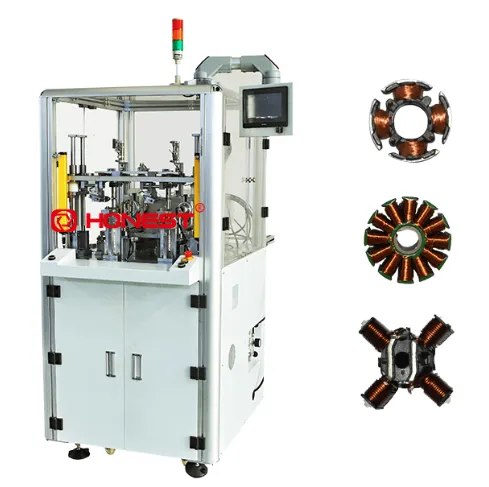
The modern electric motor industry is expanding rapidly as demand increases for energy-efficient motors used in electric vehicles, industrial automation, HVAC systems, robotics, and smart appliances. At the core of every high-performance motor is the stator, and its winding quality directly determines efficiency, torque stability, and long-term durability. To meet these demands, manufacturers rely on advanced stator winding equipment and precision-based stator winding machine technology.
The HONEST brand provides industrial-grade winding solutions designed for automated production environments, helping manufacturers achieve high accuracy, stable output, and efficient large-scale stator manufacturing.
Role of Stator Winding Equipment in Modern Motor Industry
The stator winding equipment plays a critical role in electric motor production because stator winding is responsible for generating the electromagnetic field required for motor operation. Any inconsistency in winding can lead to performance issues such as overheating, vibration, energy loss, or reduced motor lifespan.
In modern manufacturing systems, a stator winding machine ensures that every coil is placed with precise alignment and controlled tension. This automation is essential for mass production, where consistency and reliability must be maintained across thousands of units. As industries move toward electrification and smart automation, high-precision winding technology has become a core requirement.
Working Principle of Stator Winding Machine Systems
A modern stator winding machine operates through a fully automated system that integrates servo control, PLC programming, and precision mechanical motion. The process begins with automatic stator loading, followed by controlled wire feeding and programmed coil winding.
During operation, servo motors manage speed, direction, and positioning with high accuracy. The system maintains consistent wire tension throughout the winding cycle. Sensors continuously monitor the process to detect any deviation in real time. If any variation occurs, the system automatically corrects it, ensuring that the stator winding equipment delivers consistent and high-quality output.
Structure of Stator Winding Equipment Production Systems
A complete stator winding equipment production system consists of multiple coordinated modules that work together to ensure efficient manufacturing. These include automatic loading units, winding stations, insulation systems, wire feeding units, and unloading conveyors.
In advanced factories, these modules are integrated into a centralized production line system. This allows the entire stator winding machine process to operate continuously with minimal human intervention, improving productivity and reducing operational errors while maintaining consistent quality output.
Types of Stator Winding Machine Systems
Modern stator winding machine systems are designed in different configurations based on production scale and motor design requirements.
Fully Automatic Stator Winding Machine for Mass Production
These systems are designed for continuous high-volume production. They perform loading, winding, and unloading automatically, making them ideal for large industrial manufacturing environments.
Semi-Automatic Stator Winding Equipment for Flexible Production
Semi-automatic systems combine manual loading with automated winding processes. They are suitable for medium-scale production where flexibility and cost efficiency are important.
Needle Type Stator Winding Machine for Precision Motors
Needle winding machines are widely used in compact motors and BLDC applications. They provide extremely precise coil placement inside tight stator slots.
High-Speed Industrial Stator Winding Equipment Systems
These machines are designed for fast production cycles while maintaining accuracy, making them suitable for automotive and appliance motor manufacturing.
Key Features of Advanced Stator Winding Equipment Technology
Modern stator winding equipment systems are equipped with advanced features that significantly improve production efficiency and product quality.
High-precision servo control ensures accurate wire placement and stable tension throughout the winding process, improving motor performance and reducing defects.
Programmable winding systems allow manufacturers to store multiple motor configurations, enabling quick switching between different stator designs without mechanical adjustments.
Real-time monitoring systems continuously track machine performance and detect errors instantly during operation, ensuring stable production quality.
Multi-axis winding capability enables complex coil structures at high speed, supporting advanced motor designs used in modern industries.
Importance of Stator Winding Machine in Production Line Systems
In a complete motor production line, the stator winding machine is one of the most important stages because stator quality directly affects motor efficiency and performance. Proper winding ensures stable electromagnetic fields, smooth rotation, and long service life.
A stator winding equipment system ensures that every stator is produced with identical precision, which is especially important in industries such as electric vehicles and industrial automation, where performance consistency is critical for safety and reliability.
Benefits of Stator Winding Equipment Systems
One of the main benefits of stator winding equipment systems is increased production efficiency. Automation allows continuous operation with minimal downtime, resulting in higher output capacity.
Another key advantage is improved product quality. Precise winding ensures consistent electromagnetic performance across all units.
Cost efficiency is also improved because automation reduces labor requirements and minimizes production errors. Additionally, modern stator winding machine systems offer flexibility to handle multiple motor types within a single production setup.
Challenges in Stator Winding Machine Operations
Despite advanced automation, stator winding machine systems still face certain challenges.
High precision requirements are critical, as even small deviations in winding can affect motor performance. Regular maintenance and calibration are necessary to ensure long-term accuracy.
Material quality, especially copper wire and insulation materials, plays an important role in achieving reliable winding results. Another challenge is the high initial investment required for advanced stator winding equipment systems.
HONEST Solutions for Stator Winding Equipment Technology
The HONEST brand provides advanced solutions for modern stator winding equipment systems designed for industrial automation environments. These machines are built with high-precision servo control, intelligent automation systems, and flexible programming capabilities.
HONEST systems support fully automated production lines, helping manufacturers achieve stable output with minimal manual intervention. Features such as real-time monitoring, energy-efficient operation, and advanced fault detection ensure consistent production quality and reduced waste.
By using HONEST solutions, manufacturers can improve productivity, reduce operational costs, and maintain high-quality output in stator winding machine applications.
Future of Stator Winding Machine Technology
The future of stator winding machine systems is strongly connected to artificial intelligence, robotics, and smart manufacturing technologies. Fully automated factories are becoming more common, enabling faster and more accurate production.
Future innovations will include AI-based quality inspection, predictive maintenance systems, adaptive winding control, and fully digital production environments. These advancements will make stator winding equipment systems more intelligent, efficient, and reliable for global manufacturing industries.
Conclusion
A modern stator winding equipment system is essential for producing high-quality and energy-efficient electric motors. The integration of stator winding machine technology ensures precision, consistency, and scalability in modern manufacturing environments.
The HONEST brand continues to support this industry transformation by providing advanced winding solutions that improve productivity, reduce costs, and enhance motor performance. As automation continues to evolve, stator winding systems will remain a fundamental pillar of global motor production.
