
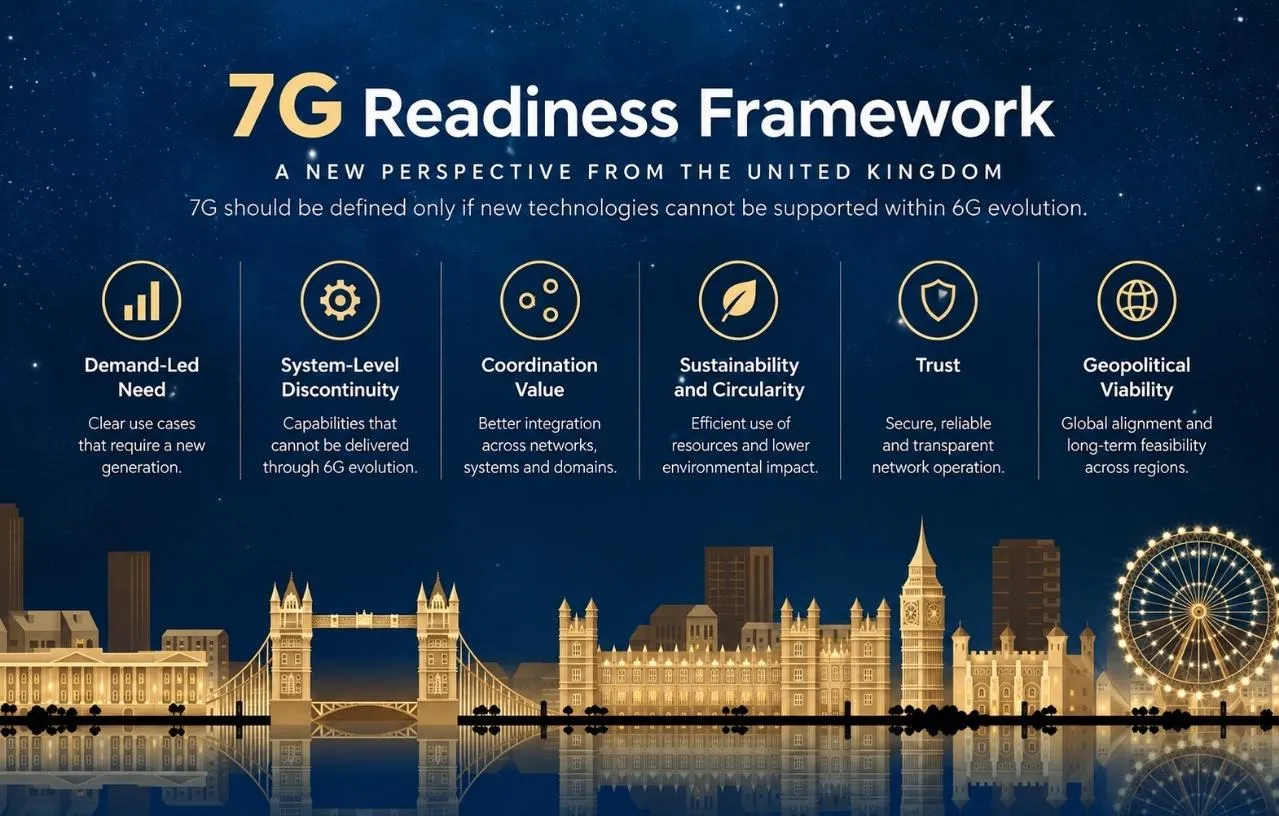
Research linked to the United Kingdom is raising an interesting technical question for the telecom sector: after 6G, will the industry actually need a separate 7G mobile generation?
A recently published research paper proposes a 7G Readiness Framework for answering this question. Rather than assuming that mobile technology must continue from 5G to 6G and then automatically to 7G, the research suggests that a new generation should be created only when there are technical requirements that cannot be supported properly through continued 6G development. So, now let us look into how United Kingdom Research Questions Whether 7G Needs to Be a New Mobile Generation along with Smart LTE RF drive test tools in telecom & Cellular RF drive test equipment and Smart Wireless Survey Software Tools & Wifi site survey software tools in detail.
This approach is different from the way future mobile generations are often discussed. Higher throughput, lower latency, additional spectrum and increased network capacity may continue to improve after 6G. However, these improvements alone may not be enough to justify defining another generation.
The main question is whether future communication systems will require a fundamental change in network architecture.
6G Already Covers a Wide Technical Scope
6G is being developed under the IMT-2030 framework. Its expected technical scope extends beyond conventional mobile broadband and includes areas such as artificial intelligence, sensing, communications, computing and integration between terrestrial and non-terrestrial networks.
This creates an important technical issue for any future 7G proposal.
Many technologies sometimes associated with 7G may eventually become part of 6G or later 6G releases. If a new capability can be introduced through software upgrades, new interfaces, additional spectrum, cloud platforms or 6G-Advanced releases, there may be no technical reason to create a separate mobile generation.
The proposed framework therefore looks for a much larger system change.
Six Tests for 7G
The research identifies six areas that can be used to assess whether 7G is technically justified: demand-led need, system-level discontinuity, coordination value, sustainability and circularity, trust, and geopolitical viability.
System-level discontinuity is especially significant.
A future technology would need to change some of the basic assumptions used to design and operate 6G networks. A simple increase in data rate, lower radio latency or better spectral efficiency would represent technical progress, but could still remain within the 6G development path.
Several possible technologies are identified that may eventually create this type of change.
One is agentic network operation, where autonomous AI agents could make network decisions and coordinate resources with considerably less direct human control.
Another is RF-native computing, which could create a much closer relationship between radio transmission and computing functions.
Quantum-enabled interworking is another candidate. Future communication infrastructure may need conventional wireless systems to work directly with quantum communication or computing systems.
The research also considers policy-aware spectrum governance, where spectrum access could become more dynamically linked with network requirements and regulatory policies.
Other possible areas include grid-interactive infrastructure, where telecom networks coordinate their operation with electrical power systems, and outcome-assured services, where networks are designed around delivering a required service result rather than only maintaining traditional network performance parameters.
7G May Not Follow the Traditional Generation Model
The research does not define a 7G architecture, frequency range, air interface or deployment date. It also does not claim that 7G is certain to happen.
Instead, it provides a technical method for deciding whether another mobile generation will eventually be required.
This distinction could become increasingly relevant as networks become more software-controlled. Previous mobile generations introduced major changes to radio technology and network architecture. Future networks may be able to introduce significant new capabilities through software, cloud infrastructure, AI and modular network functions without replacing the underlying generation.
If 6G and 6G-Advanced can support future requirements through continuous development, the industry could remain on an extended 6G technology cycle.
A separate 7G generation would become technically meaningful when new applications, network architectures or infrastructure relationships reach a point where 6G can no longer support them efficiently.
The 7G Readiness Framework therefore changes the discussion from “What will 7G deliver?” to a more practical engineering question:
“What technical requirement would make 7G necessary?”
That question may eventually determine whether 7G becomes the next defined mobile generation or whether the industry moves towards continuous post-6G network development.
About RantCell
RantCell is a mobile network testing and monitoring solution for measuring 4G LTE, 5G, private network and Wi-Fi performance using Android devices. It supports RF drive testing, indoor walk testing, network benchmarking, automated testing and QoE monitoring, with test data analysed through web-based dashboards and reports. RantCell helps network teams perform field measurements at scale while reducing dependency on traditional test equipment and manual post-processing. Also read similar articles from here.
