
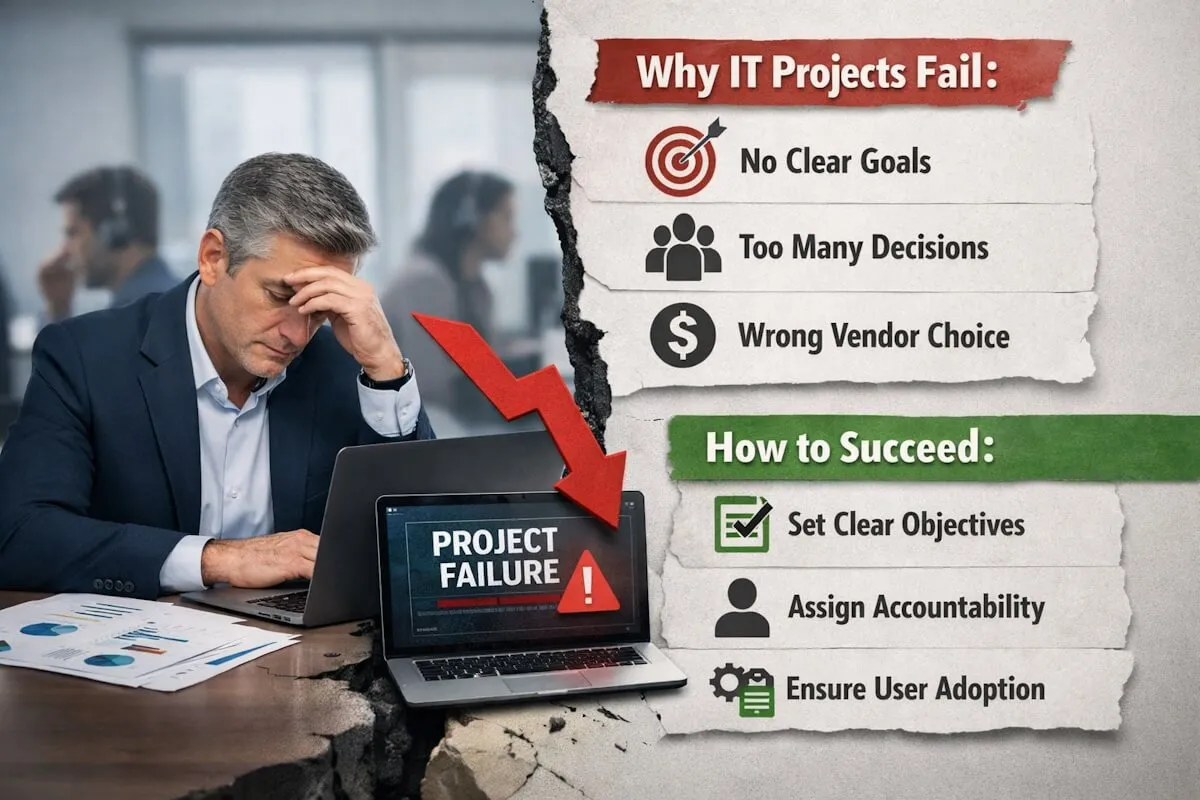
You’ve approved the budget. You’ve signed off on the roadmap. The team promised results. Months go by. Then a year. And somehow, that big IT investment you were counting on… just doesn’t deliver.
Sound familiar?
You’re not alone. Many CEOs and business leaders pour serious money into tech, expecting growth, speed, or cost savings. Instead, they get delays, confusion, or tools no one really uses.
So what’s going wrong? And more importantly, what can you actually do about it?
Let’s break it down.
The Real Problem Isn’t Technology
It’s easy to blame the tools. Or the developers. Or even the vendor. But most failed IT projects don’t collapse because of bad code.
They fail because of bad decisions.
Think about it. How often are projects approved based on trends instead of actual needs? Someone says, “We need AI,” or “Let’s move everything to the cloud,” and suddenly there’s a massive project in motion.
But pause for a second.
Did anyone clearly define the business problem first?
If your IT investment isn’t tied directly to a specific business outcome, you’re already off track.
Lack of Clear Goals Kills Momentum
A lot of companies jump into projects with vague expectations.
“We want to improve efficiency.”
“We want better customer experience.”
“We want to scale.”
That sounds fine, but it’s not enough.
What does “better” actually mean? Faster response time? Lower costs? Higher retention?
Without clear, measurable goals, your team ends up guessing. And when everyone is guessing, progress slows down.
You need targets that leave no room for confusion. Something like:
- Reduce support response time by 40%
- Cut operational costs by 20%
- Increase conversion rates by 15%
Now your team has direction.
Too Many Decision Makers, Not Enough Accountability
Here’s another common issue.
Everyone wants a say. The CEO, CTO, department heads, consultants. Meetings pile up. Opinions clash. Decisions get delayed.
And when something goes wrong?
No one owns it.
This kind of setup drains projects. Teams lose focus. Priorities shift every other week.
You don’t need more voices. You need clear ownership.
Assign one person who is responsible for outcomes. Not just progress updates. Actual results.
Choosing Vendors Based on Cost Alone
Let’s be honest. Budget matters.
But picking the cheapest vendor often leads to bigger expenses later.
Lower costs can mean less experience, poor communication, or shortcuts in development. That’s when you start seeing missed deadlines, rework, and systems that don’t scale.
Instead of asking “Who’s the cheapest?” try asking:
- Do they understand my business?
- Have they solved similar problems before?
- Can they challenge my ideas when needed?
That’s where real value comes in.
Working with the right partner for IT Consulting Services can save you from costly mistakes early on. A good consultant won’t just build what you ask. They’ll question it. Refine it. Sometimes even push back.
And that’s a good thing.
No Alignment Between Business and Tech Teams
This one’s huge.
Your business team talks in terms of revenue, customers, and growth. Your tech team talks about systems, frameworks, and timelines.
Both are right. But if they don’t align, projects stall.
You might think everyone is on the same page. They’re not.
The business team wants speed. The tech team wants stability. Without proper communication, you end up with friction.
So what’s the fix?
Translate business goals into technical priorities. And do it early.
Don’t wait until development starts. Bring both sides together during planning. Let them challenge each other.
That’s where clarity happens.
Overbuilding Instead of Solving
Here’s a trap many companies fall into.
They try to build the “perfect” system from day one.
Every feature. Every scenario. Every future need.
What happens next?
Delays. Budget overruns. Complexity.
And by the time the product is ready, the market has already shifted.
You don’t need perfection. You need progress.
Start small. Focus on solving one core problem really well. Then build from there.
This approach keeps things manageable. It also gives you room to adjust based on real feedback.
Ignoring User Adoption
You can build the best system in the world. If no one uses it, it’s useless.
Many IT investments fail because employees don’t adopt the new tools.
Why?
- They’re too complex
- No proper training
- Change wasn’t communicated well
People resist change. That’s normal.
If you want adoption, involve users early. Get their feedback. Make them part of the process.
And once the system is ready, don’t just launch it and walk away.
Train your team. Support them. Show them how this new system actually helps their day-to-day work.
Poor Project Visibility
Ever felt like you don’t really know what’s happening inside a project?
You get updates. Reports. Dashboards. But still, something feels off.
That’s a visibility problem.
If you can’t clearly see progress, risks, and blockers, you can’t make informed decisions.
And when issues finally surface, it’s usually too late.
You need transparency.
Regular check-ins. Clear metrics. Honest conversations.
Not everything will go perfectly. And that’s fine. What matters is catching issues early.
CEOs Staying Too Distant
Let’s talk about leadership.
Some CEOs approve budgets and then step back completely. They trust the team to handle everything.
Trust is good. Absence is not.
You don’t need to micromanage. But you do need to stay involved.
Ask questions. Challenge assumptions. Review progress.
Your involvement signals importance. It keeps everyone aligned and accountable.
Even a short weekly check-in can make a big difference.
How CEOs Can Actually Fix This
Alright, enough about what’s going wrong.
Let’s talk about what you can do differently.
Start With Business Outcomes
Before any project begins, ask one simple question:
“What problem are we solving?”
Not what tool you’re using. Not what features you want.
Focus on outcomes.
Tie every decision back to that.
Bring in the Right Expertise Early
Don’t wait until things go off track.
Bring in experts during planning.
If you’re not sure how to approach a project, it’s smart to Hire IT Consultants who can guide you from day one.
They can help you define scope, identify risks, and avoid common pitfalls.
That early guidance can save months of rework.
Keep Projects Lean
Avoid overcomplicating things.
Break projects into smaller phases. Deliver value quickly. Learn from it.
Then move forward.
This keeps momentum high and reduces risk.
Build a Culture of Accountability
Make ownership clear.
Every project should have someone responsible for results. Not just tasks.
Set expectations early. Review progress regularly.
And when things go off track, address it quickly.
Prioritize Communication
Don’t assume alignment. Create it.
Encourage open discussions between business and tech teams.
Make sure everyone understands the goals. Not just their tasks.
Clarity reduces confusion. Simple as that.
Focus on Adoption, Not Just Delivery
A project isn’t done when it’s launched.
It’s done when people actually use it.
Plan for training. Support. Feedback loops.
Keep improving based on how users interact with the system.
A Quick Reality Check
Not every IT investment will succeed.
And that’s okay.
What matters is how quickly you learn and adjust.
Are you catching issues early?
Are you making better decisions over time?
Are your projects getting closer to actual business goals?
That’s the real measure of success.
Let’s Wrap This Up With Something Useful
If you take one thing from this, let it be this:
Technology doesn’t fix business problems. People do.
The tools are just part of the equation.
Your decisions, your leadership, your clarity. That’s what drives results.
So next time you’re about to approve an IT investment, pause for a moment.
Ask the tough questions. Challenge assumptions. Stay involved.
Because when you get it right, the impact is huge.
And when you don’t… well, you already know how that goes.
